MAVEN Mission Ends: Decades of Mars Atmospheric Insights Conclude
June 9, 2026, 9:36 am

Location: United States
Employees: 10001+
Founded date: 1958
Total raised: $25.7B
NASA's MAVEN Mars orbiter concludes its groundbreaking 11-year mission. Launched in 2013, MAVEN fundamentally reshaped understanding of the Martian atmosphere, its evolution, and critical interactions with the solar wind. A signal loss in December 2025 led to its eventual unrecoverable state, declared officially in June 2026. The mission's invaluable data illuminated atmospheric erosion by solar storms, unveiled unique Martian auroras, and provided essential insights for future human exploration of the Red Planet. Its legacy will inform planetary science for generations.
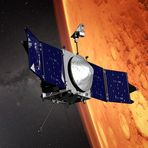
NASA's Mars Atmosphere and Volatile EvolutioN (MAVEN) mission has officially concluded. After over a decade observing the Red Planet, the spacecraft ceased operations. Its final communication occurred December 6, 2025. NASA's investigation board declared MAVEN unrecoverable in June 2026. This marks the end of a pivotal mission. It profoundly advanced understanding of Mars' atmospheric history.
MAVEN launched in November 2013. It reached Mars in September 2014. The mission was the first dedicated to the Martian atmosphere. Its primary goal was to study the upper atmosphere and ionosphere. Researchers sought to understand interactions with the Sun. Specifically, MAVEN investigated how Mars lost its atmosphere to space. This process holds keys to the planet's past climate.
The spacecraft was initially designed for a one-year mission. Its operational life far exceeded expectations. MAVEN continued collecting data for more than 11 years. Its fuel supply was projected to last until 2030. Up until its final moments, MAVEN gathered crucial information. Scientists aimed to determine if Mars was once habitable.
The end came unexpectedly. All systems worked normally before MAVEN passed behind Mars. This occurred in December 2025. After emergence, NASA's Deep Space Network received no signal. A brief data fragment emerged from radio signal analysis. It indicated MAVEN was in safe mode. The spacecraft was rotating at an unusually high rate. This suggested a disruption to its orbit trajectory.
The NASA anomaly review board conducted an inquiry. Its preliminary findings detailed the failure. The high-speed rotation drained MAVEN's batteries. This caused a loss of power to its communication system. The spacecraft became unrecoverable. The board continues to investigate the root cause of this anomaly. A final report is expected later this year. MAVEN will continue to orbit Mars for 50 to 100 years. Then it will crash through the Martian atmosphere.
MAVEN delivered exceptional scientific returns. It provided unprecedented insights into the Martian atmosphere. One major discovery involved solar storms. These events dramatically increase atmospheric erosion. The mission showed how solar wind strips away the atmosphere. This process transformed Mars from a potentially habitable world. It became the cold, dry planet seen today. MAVEN was unique. It simultaneously measured the Sun and the Martian atmospheric response.
The mission identified several types of auroras on Mars. These light displays occur when energetic particles impact the atmosphere. They cause gases to glow. MAVEN specifically proved the existence of proton auroras on Mars. On Earth, these auroras are limited to polar regions. On Mars, they can be observed globally. MAVEN also revealed a new atmospheric process: sputtering. Charged particles crash into the upper atmosphere. They splash out into space.
MAVEN's observations extended beyond core atmospheric studies. In 2024, it helped monitor a severe geomagnetic storm. This was the biggest space weather event in 20 years. It significantly disturbed Earth’s magnetic field. In 2018, MAVEN studied a massive dust storm. This storm enveloped the entire Red Planet. The spacecraft even observed unexpected celestial events. It collected data on X-ray radiation from a black hole binary system. MAVEN imaged the rare interstellar comet 3I/ATLAS in 2025.
The mission was a collaborative triumph. The University of Colorado Boulder's Laboratory for Atmospheric and Space Physics (LASP) led the effort. Hundreds of students, professors, and researchers contributed. MAVEN's success represents one of NASA's largest contracts with the university.
MAVEN's data holds immense value for future endeavors. The insights are crucial for human missions to Mars. They inform radiation protection and safety measures. The vast dataset will be archived. It will continue to provide new knowledge for decades. MAVEN's operational lessons are vital. They build a foundation for subsequent space exploration. The mission leaves a profound scientific legacy. It expanded planetary science, heliophysics, and even astrophysics. MAVEN truly transformed understanding of Mars' evolutionary path.
NASA's Mars Atmosphere and Volatile EvolutioN (MAVEN) mission has officially concluded. After over a decade observing the Red Planet, the spacecraft ceased operations. Its final communication occurred December 6, 2025. NASA's investigation board declared MAVEN unrecoverable in June 2026. This marks the end of a pivotal mission. It profoundly advanced understanding of Mars' atmospheric history.
MAVEN launched in November 2013. It reached Mars in September 2014. The mission was the first dedicated to the Martian atmosphere. Its primary goal was to study the upper atmosphere and ionosphere. Researchers sought to understand interactions with the Sun. Specifically, MAVEN investigated how Mars lost its atmosphere to space. This process holds keys to the planet's past climate.
The spacecraft was initially designed for a one-year mission. Its operational life far exceeded expectations. MAVEN continued collecting data for more than 11 years. Its fuel supply was projected to last until 2030. Up until its final moments, MAVEN gathered crucial information. Scientists aimed to determine if Mars was once habitable.
The end came unexpectedly. All systems worked normally before MAVEN passed behind Mars. This occurred in December 2025. After emergence, NASA's Deep Space Network received no signal. A brief data fragment emerged from radio signal analysis. It indicated MAVEN was in safe mode. The spacecraft was rotating at an unusually high rate. This suggested a disruption to its orbit trajectory.
The NASA anomaly review board conducted an inquiry. Its preliminary findings detailed the failure. The high-speed rotation drained MAVEN's batteries. This caused a loss of power to its communication system. The spacecraft became unrecoverable. The board continues to investigate the root cause of this anomaly. A final report is expected later this year. MAVEN will continue to orbit Mars for 50 to 100 years. Then it will crash through the Martian atmosphere.
MAVEN delivered exceptional scientific returns. It provided unprecedented insights into the Martian atmosphere. One major discovery involved solar storms. These events dramatically increase atmospheric erosion. The mission showed how solar wind strips away the atmosphere. This process transformed Mars from a potentially habitable world. It became the cold, dry planet seen today. MAVEN was unique. It simultaneously measured the Sun and the Martian atmospheric response.
The mission identified several types of auroras on Mars. These light displays occur when energetic particles impact the atmosphere. They cause gases to glow. MAVEN specifically proved the existence of proton auroras on Mars. On Earth, these auroras are limited to polar regions. On Mars, they can be observed globally. MAVEN also revealed a new atmospheric process: sputtering. Charged particles crash into the upper atmosphere. They splash out into space.
MAVEN's observations extended beyond core atmospheric studies. In 2024, it helped monitor a severe geomagnetic storm. This was the biggest space weather event in 20 years. It significantly disturbed Earth’s magnetic field. In 2018, MAVEN studied a massive dust storm. This storm enveloped the entire Red Planet. The spacecraft even observed unexpected celestial events. It collected data on X-ray radiation from a black hole binary system. MAVEN imaged the rare interstellar comet 3I/ATLAS in 2025.
The mission was a collaborative triumph. The University of Colorado Boulder's Laboratory for Atmospheric and Space Physics (LASP) led the effort. Hundreds of students, professors, and researchers contributed. MAVEN's success represents one of NASA's largest contracts with the university.
MAVEN's data holds immense value for future endeavors. The insights are crucial for human missions to Mars. They inform radiation protection and safety measures. The vast dataset will be archived. It will continue to provide new knowledge for decades. MAVEN's operational lessons are vital. They build a foundation for subsequent space exploration. The mission leaves a profound scientific legacy. It expanded planetary science, heliophysics, and even astrophysics. MAVEN truly transformed understanding of Mars' evolutionary path.